
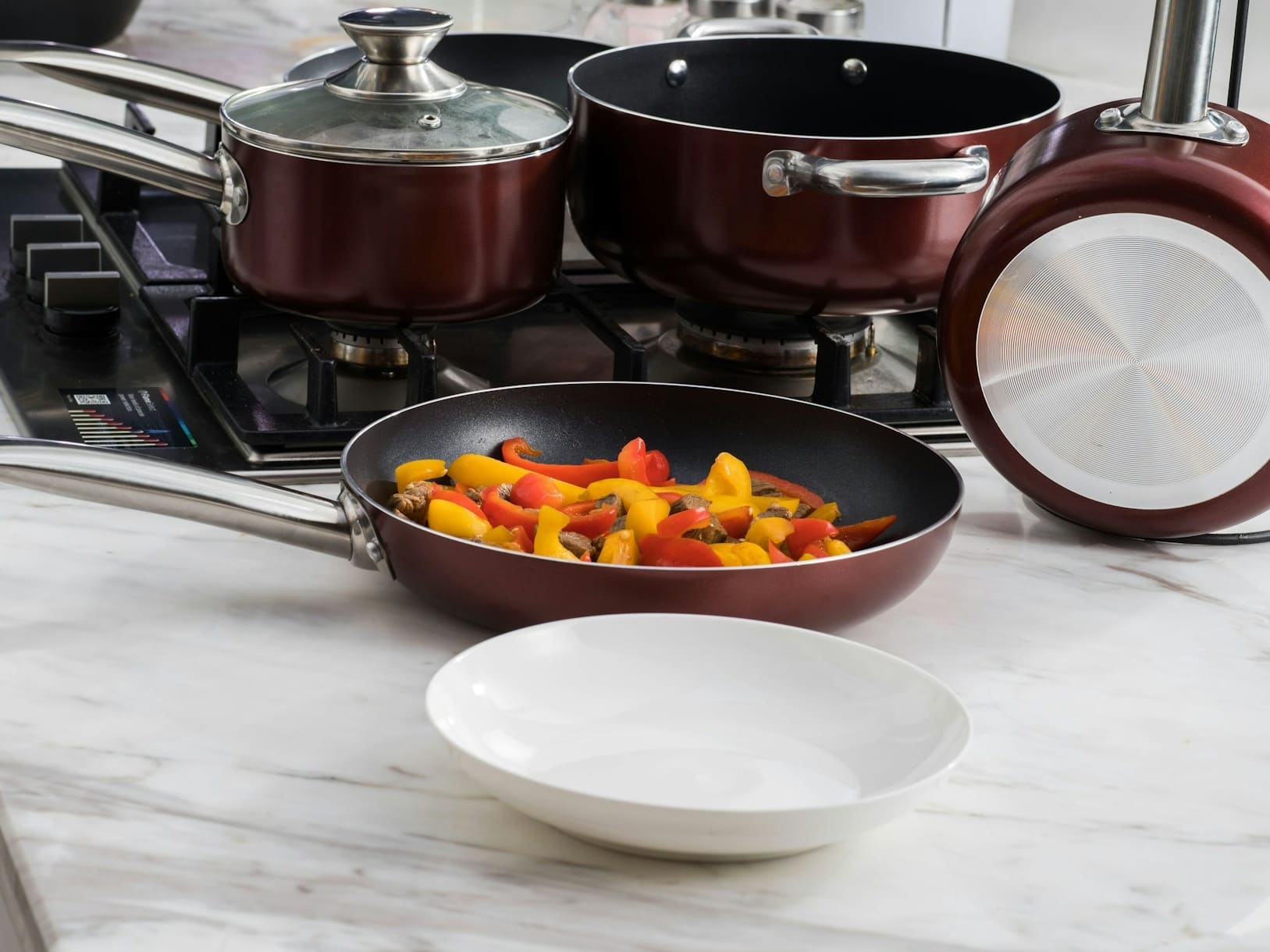
Which Cookware Is Best for What You Cook?
Starting with the food rather than the material makes buying cookware much easier.
| What You Cook | Useful Cookware |
|---|---|
| Steak | Cast-iron, carbon-steel, or suitable stainless-steel skillet |
| Eggs | Nonstick skillet |
| Pancakes | Nonstick skillet or suitable griddle |
| Tomato pasta | Stockpot + skillet or sauté pan |
| Soup | Saucepan, stockpot, or Dutch oven depending on quantity |
| Beef stew | Dutch oven |
| Stir-fry | Wok |
| Fried rice | Wok or suitable large skillet |
| Pasta | Large pot or stockpot |
| Pan sauce | Stainless-steel skillet or sauté pan |
| Roast chicken | Suitable roasting pan or oven-safe vessel |
These aren’t strict rules. Multiple pieces of cookware can often accomplish the same job.
Stainless Steel vs Nonstick
This is one of the most useful comparisons for a beginner.
Stainless steel is particularly useful when you want:
- Browning
- Searing
- Pan sauces
- Durability
- A versatile everyday cooking surface
Nonstick is particularly useful when you want:
- Easy egg cooking
- Pancakes
- Easier release of delicate foods
- Convenient cleanup
You don’t have to choose one permanently.
For many kitchens, having one versatile stainless-steel pan and one smaller nonstick pan for delicate foods is more practical than trying to make a single pan perfect at everything.
Stainless Steel vs Cast Iron
These materials also solve different problems.
Stainless steel
Generally offers:
- Versatility
- Easier everyday handling
- Lower maintenance
- Good browning capability
Cast iron
Offers:
- Excellent heat retention
- Strong searing performance
- Stovetop-to-oven versatility when the specific cookware permits it
Cast iron’s extra weight and maintenance can make stainless steel more convenient for some cooks.
The better option depends on what you value.
What About Induction Cooktops?
Don’t assume a pan will work on induction simply because its general material category sounds compatible.
Check the cookware manufacturer’s specifications for explicit induction compatibility.
A simple magnet test is sometimes used as a quick indication with existing cookware, but manufacturer compatibility information is a better basis when purchasing a new pan because cookware construction can vary.
A Practical Beginner Cookware Collection
You don’t need a 15-piece matching set.
A more useful starting collection might be:
1. One skillet
For frying, browning, sautéing, and quick meals.
2. One saucepan
For rice, sauces, oatmeal, vegetables, and smaller quantities of soup.
3. One medium or large pot
For pasta, soup, and larger-volume cooking.
4. One oven-safe baking or roasting vessel
For oven meals and roasted foods.
That small collection can already handle a large percentage of everyday cooking.
What to Add Later
Once you know what you actually cook, consider adding:
- Dutch oven
- Cast-iron skillet
- Nonstick skillet
- Sauté pan
- Stockpot
- Wok
- Roasting pan
There’s little advantage in buying specialty cookware before you have a reason to use it.
7 Questions to Ask Before Buying a Pan
Before spending money, ask:
1. What will I cook in it?
Name actual meals rather than imagining hypothetical uses.
2. Does it work with my cooktop?
Especially important for induction.
3. Can I comfortably lift it?
Consider the weight when the pan is full, not only when empty.
4. Is the handle comfortable and secure?
Handle design matters during everyday use.
5. Can it go in the oven?
Check the manufacturer’s maximum temperature and restrictions if this matters to you.
6. How much maintenance does it require?
Be realistic about whether you’re willing to season and maintain certain cookware.
7. Do I already own something that does the same job?
A new pan isn’t necessarily useful just because it has a different name.
Cookware Care Depends on the Material
There isn’t one cleaning method that’s correct for every pan.
Stainless steel
Follow the manufacturer’s cleaning recommendations and avoid unnecessarily aggressive cleaning methods.
Traditional cast iron
Dry it thoroughly and maintain its seasoning according to appropriate care instructions.
Carbon steel
Traditional carbon steel also requires attention to drying and seasoning.
Nonstick
Follow the manufacturer’s guidance on:
- Utensils
- Heat
- Cleaning
- Dishwasher use
- Oven use
Avoid assuming a utensil or cleaning method is safe just because it worked on another pan.
Copper
Follow the specific manufacturer’s instructions, especially for cookware with a lined cooking surface.
Common Cookware Buying Mistakes
Buying a Huge Set First
A large set can look like better value, but only if you actually use the pieces.
Four useful pans are better than 12 pieces occupying cabinet space.
Choosing by Appearance Alone
A beautiful pan still needs to work with your stove and cooking style.
Ignoring Weight
A heavy pan may perform well but become frustrating if you dislike lifting it.
Forgetting Cooktop Compatibility
Always check before purchasing, especially with induction.
Assuming Every Pan Can Handle High Heat
Temperature limits depend on the cookware’s construction, coating, handles, and other components.
Follow the manufacturer’s instructions.
Using the Wrong Utensils on Coated Cookware
A cooking surface can be damaged by practices its manufacturer specifically warns against.
Buying Specialized Cookware Too Early
Start broad.
Add specialized pieces only when your cooking habits reveal a real need.
The best cookware collection isn’t the biggest or necessarily the most expensive. Start with a useful skillet, saucepan, larger pot, and oven-safe vessel, then pay attention to the meals you repeatedly cook. If you regularly sear meat, cast iron or carbon steel may become worthwhile. If you make stir-fries every week, add a wok. If eggs are part of your daily routine, a dedicated nonstick skillet may earn its cabinet space. Build the collection around your cooking—not around the number of pieces included in a box.
Related Recipes
 How to Properly Care for Kitchen Knives: A Complete Kitchen Knife Care Guide
 Essential Kitchen Tools Every Beginner Needs: A Practical Starter Guide
 How to Keep Your Kitchen Clean While Cooking: 15 Practical Kitchen Cleaning Tips
 How to Make Crispy Food in the Oven: Golden, Crunchy Results Every Time