
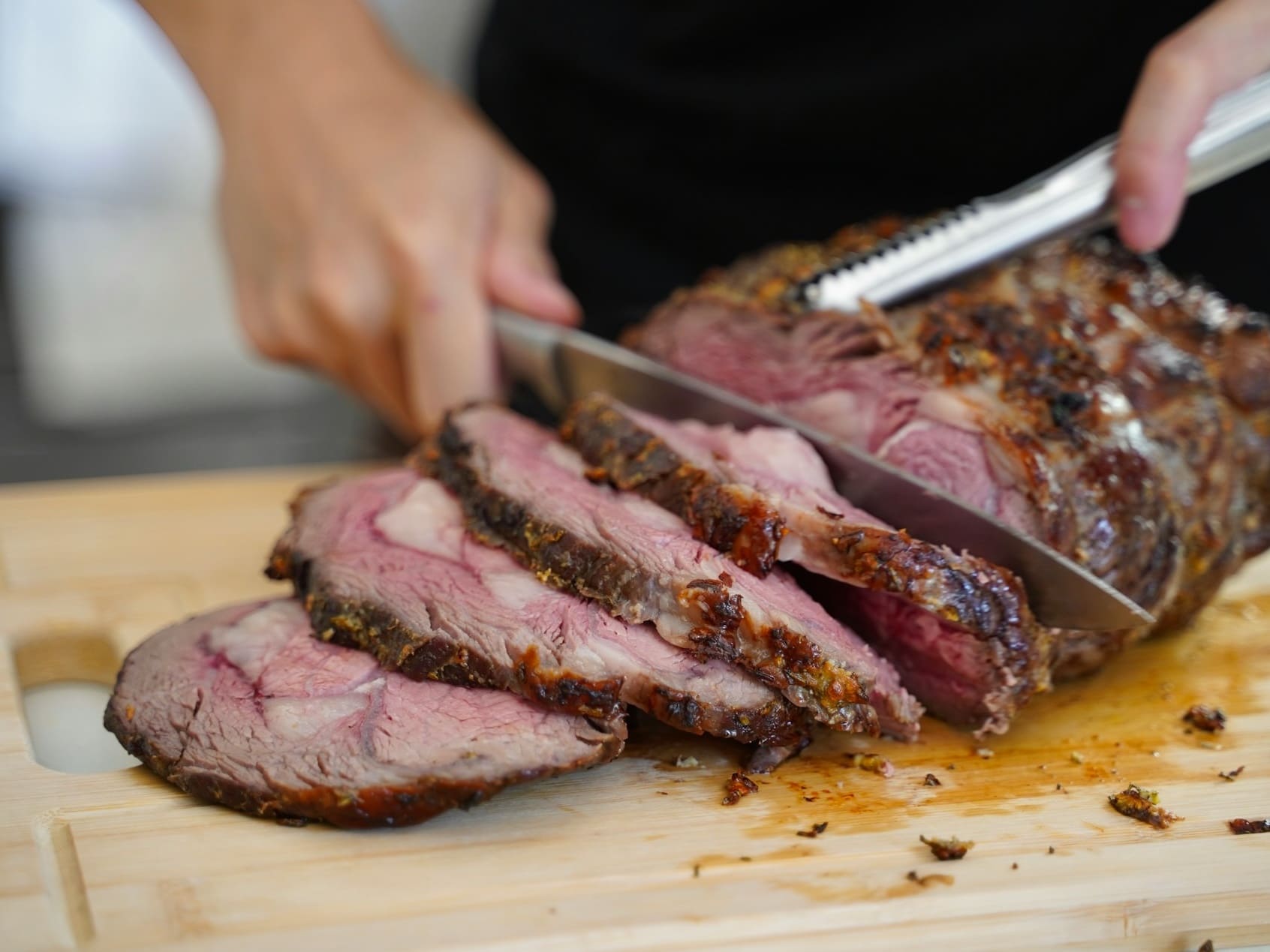
Can You Tell If Meat Is Cooked Without a Thermometer?
You can observe how meat changes during cooking, but those clues don’t reliably establish microbiological safety.
Color
Color can help you monitor cooking, but don’t use it as your safety test.
Meat can brown before the center reaches its safe minimum, and safely cooked meat can sometimes retain pink coloration. FoodSafety.gov specifically advises that color and texture aren’t reliable indicators of safety. (FoodSafety.gov)
Texture
Meat generally becomes firmer as proteins change during cooking.
But firmness varies with the cut, thickness, cooking method, fat content, and desired result.
Touch can help an experienced cook assess culinary doneness, but it doesn’t give you an internal temperature.
Juices
“Clear juices mean chicken is done” is not a reliable safety rule.
Juice appearance cannot tell you whether the thickest part has reached 165°F.
Use the thermometer.
How to Check Thin Pieces of Meat
Thin foods can be awkward because inserting a thermometer vertically from the top may push the sensing area straight through the food.
Depending on your thermometer’s design, inserting the probe from the side into the thickest area can help keep the sensing portion inside the meat.
The important point is that you’re measuring the food itself—not the pan, bone, or empty space beyond it.
How to Check a Large Roast
One measurement may not adequately represent a large or irregularly shaped roast.
Check more than one appropriate location, especially when:
- The roast is particularly large
- Thickness varies
- There are bones
- Several pieces are cooking together
The coldest relevant reading is more useful than finding one conveniently hot location.
How to Tell When Meat Is Cooked on the Grill
Grilling makes visual judgment especially tempting.
A steak can have dark grill marks while its center remains far cooler. Likewise, a burger can become heavily browned outside before its center reaches the required temperature.
Near the expected end of cooking, check the internal temperature in an appropriate thick section.
Don’t Let Grill Marks Fool You
Grill marks tell you about contact between the meat and the hot grill.
They don’t measure the internal temperature.
Treat browning as a flavor and appearance characteristic—not proof of safety.
Avoid Cross-Contamination at the Grill
The thermometer isn’t the only safety consideration.
Don’t place cooked meat back onto a plate that held raw meat unless that plate has been properly washed. Keep raw meat and poultry separate from ready-to-eat foods, and properly clean utensils and surfaces that have contacted raw products. FoodSafety.gov recommends separating raw meat from ready-to-eat foods and washing food-contact equipment appropriately. (FoodSafety.gov)
A common mistake looks like this:
RAW BURGERS ON PLATE → BURGERS GO ON GRILL → COOKED BURGERS RETURN TO SAME UNWASHED PLATE
Instead, have a clean plate ready for the cooked food.