
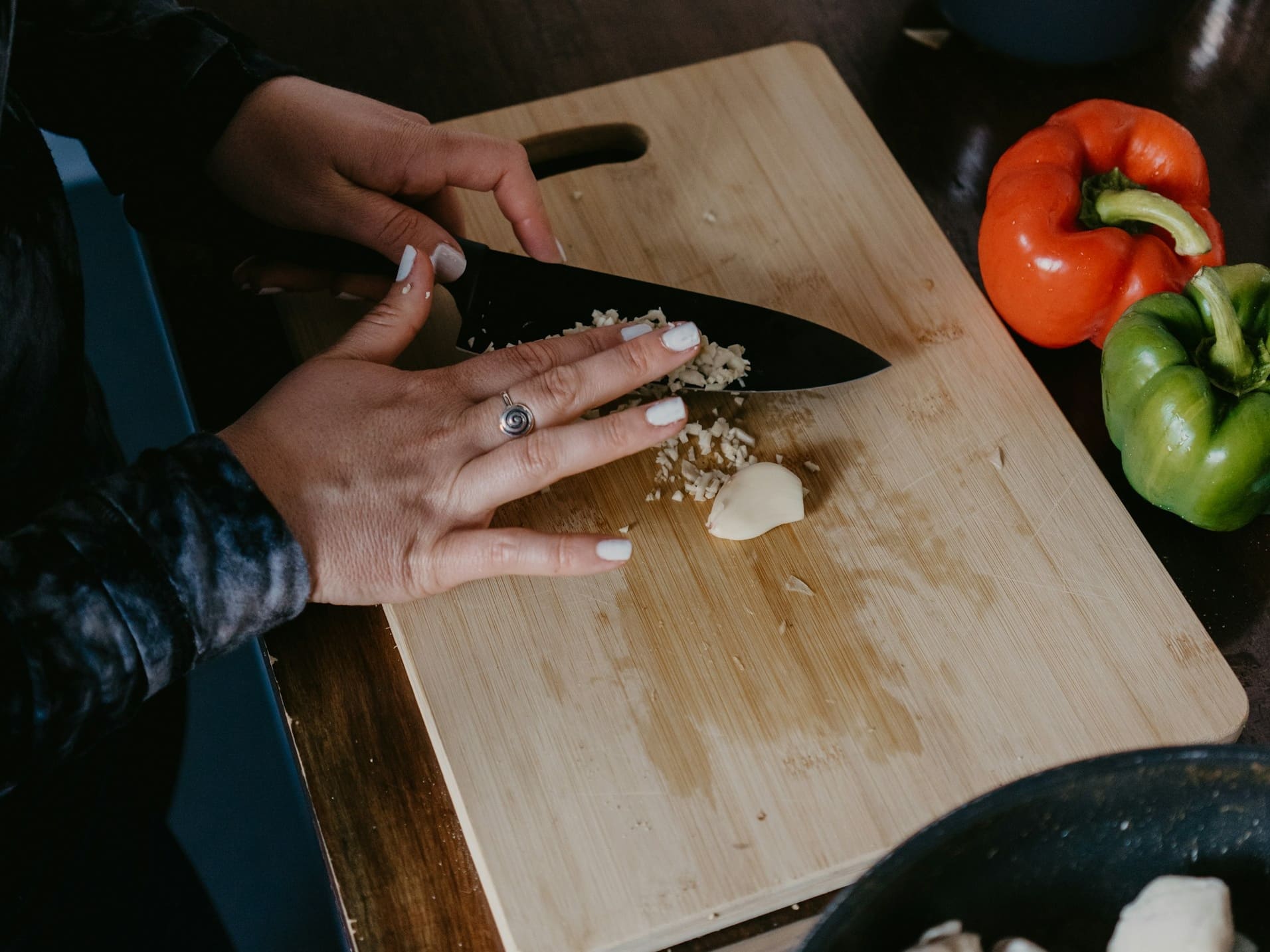
Wood Cutting Boards
Wood remains a popular option for everyday food preparation.
A substantial wooden board can provide a large, stable work surface and can last a long time when maintained according to its manufacturer’s instructions.
The FDA Food Code permits hard maple and equivalently hard, close-grained wood for cutting boards in specified food-service applications. (U.S. Food and Drug Administration)
Wood may be right for you if:
- You do a lot of everyday chopping and slicing.
- You want a substantial board that stays on the counter.
- You don’t mind hand washing and additional maintenance.
- You value the feel of the cutting surface.
Think twice if:
You want something you can simply put through the dishwasher after every use. Care instructions vary by board, so follow the manufacturer’s directions rather than assuming a wooden board can be cleaned the same way as plastic.
Plastic Cutting Boards
Plastic is particularly practical when convenience is the priority.
It’s lightweight, available in many sizes, and many nonporous plastic boards can be dishwasher-safe—although you should verify the manufacturer’s instructions for your particular board. FDA guidance specifically notes that plastic or other nonporous boards can be run through the dishwasher after use. (U.S. Food and Drug Administration)
Plastic can also make sense as a dedicated board for raw meat, poultry, and seafood.
Its weakness appears as it wears.
Knife cuts can eventually create deep grooves that become increasingly difficult to clean. USDA recommends replacing boards once they become excessively worn or develop hard-to-clean grooves. (Ask USDA)
What About Bamboo?
Bamboo boards can provide a hard, relatively lightweight cutting surface and are widely available.
Don’t assume every bamboo board will perform identically, though. Construction, thickness, finish, and manufacturer care requirements can vary.
If you’re considering bamboo, pay attention to the actual board rather than buying purely because the label says “bamboo.”
Check:
- Thickness
- Construction quality
- Stability
- Manufacturer’s washing instructions
- Recommended maintenance
Composite Cutting Boards
Composite boards can be useful if you want something between traditional wood and basic plastic.
They’re generally designed for durability and easier maintenance, but products differ substantially.
Check whether the specific board is dishwasher-safe and whether the manufacturer has any restrictions on cleaning, heat exposure, or maintenance.
Rubber Cutting Boards
Rubber boards deserve consideration if stability is high on your priority list.
They’re often substantial and provide a surface designed for repeated knife work.
Their weight can be either an advantage or disadvantage: a heavier board tends to stay in place, but it can also be less convenient to move, wash, and store.
Why Glass and Stone Aren’t Good Everyday Cutting Surfaces
A glass or stone board can look attractive and feel easy to wipe clean, but those aren’t the only qualities that matter.
These materials create extremely hard surfaces for your knife edge.
If you want a glass surface for serving or another specialized purpose, that’s different. For routine chopping and slicing, choose a material designed to function as an everyday cutting surface.