
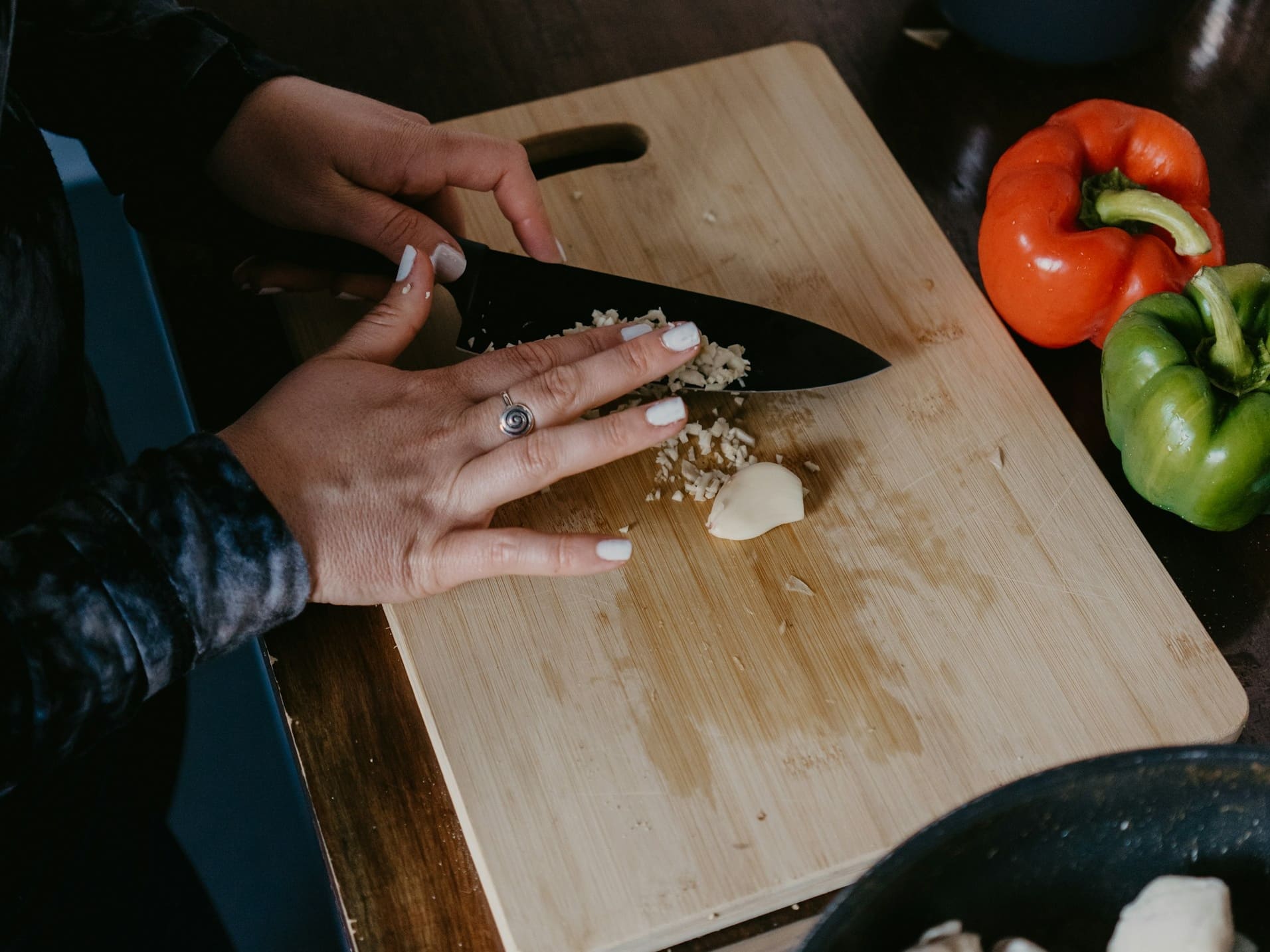
Choosing a Cutting Board for Raw Meat
When preparing raw meat, poultry, or seafood, the main issue isn’t finding a special “meat material.”
You need a board that can be cleaned thoroughly and kept from contaminating foods that won’t receive further cooking.
USDA advises washing cutting boards with hot, soapy water after preparing each food item and before moving to the next. It also recommends keeping raw meat, poultry, seafood, and their juices away from ready-to-eat foods. (Ask USDA)
Having a separate board makes that routine easier.
You might even choose a different color so it’s immediately obvious which board you reserve for raw proteins.
Do You Absolutely Need Two Boards?
Not necessarily.
If you only have one board, FDA guidance recommends preparing fruits and vegetables first, putting them aside, thoroughly washing the board with soap and hot water, and then preparing raw meat, poultry, or seafood. (U.S. Food and Drug Administration)
But if you regularly cook raw proteins, a second board is a simple way to make separation easier.
When Should You Replace a Cutting Board?
Don’t judge a board by age alone.
Look at its actual condition.
Consider replacement when you notice:
- Deep grooves that are difficult to clean
- Significant cracks
- Splitting
- Serious warping
- An unstable surface
- Excessive wear that makes thorough cleaning difficult
USDA specifically advises replacing excessively worn cutting boards or boards with hard-to-clean grooves. (Ask USDA)
A few normal knife marks don’t automatically mean a board belongs in the trash. The concern is deterioration that interferes with cleaning or normal use.
How to Care for Your Cutting Board
Start with one rule:
Follow the manufacturer’s care instructions for your particular board.
Different materials shouldn’t automatically receive identical treatment.
After food preparation
Wash the cutting board appropriately before using it for another food, particularly after raw meat, poultry, or seafood.
FDA and USDA guidance recommends washing cutting boards and other food-contact items with hot, soapy water between food-preparation tasks. (U.S. Food and Drug Administration)
For wooden boards
Avoid prolonged soaking and allow the board to dry properly.
If the manufacturer recommends conditioning the board with an appropriate product, follow its directions for how and when to apply it.
For plastic boards
Wash promptly after use.
If the manufacturer identifies the board as dishwasher-safe, using the dishwasher can make cleanup particularly convenient.
Common Cutting Board Buying Mistakes
Buying a board that’s too small
A compact board may save storage space but become irritating when you’re constantly pushing chopped vegetables back onto it.
Choose based on your normal preparation jobs.
Ignoring your sink size
This is easy to overlook.
Before buying an enormous wooden board, make sure you have a practical way to wash it.
Choosing appearance over function
A beautiful board that slides, rocks, doesn’t fit your workspace, or is inconvenient to maintain isn’t a good everyday tool.
Assuming every board can go in the dishwasher
Check the manufacturer’s instructions first.
Keeping a badly damaged board
Deep, difficult-to-clean grooves and significant damage aren’t merely cosmetic reasons to inspect or replace a board.
Using the same dirty board for raw and ready-to-eat foods
Wash it thoroughly between tasks or use separate boards to reduce the chance of cross-contamination. (Ask USDA)
The Simplest Cutting Board Setup for Most Kitchens
You don’t need six boards.
For many home cooks, a useful setup is:
One medium-to-large everyday board
Choose wood, plastic, composite, or another appropriate cutting surface based on your maintenance preferences.
One separate easy-to-clean board for raw proteins
This makes separating raw meat, poultry, and seafood from produce and ready-to-eat foods much easier.
If you rarely prepare raw animal proteins, your needs may be simpler.
Cutting Board Buying Checklist
Before buying, ask:
- Is it large enough for the food I normally prepare?
- Does it fit comfortably on my counter?
- Can I wash it easily in my sink or dishwasher?
- Does it sit flat and feel stable?
- Am I comfortable with its maintenance requirements?
- Is the surface appropriate for regular knife work?
- Is it too heavy for me to move and clean conveniently?
- Do I want a separate board for raw meat, poultry, and seafood?
- Do I have somewhere practical to store it?
The right cutting board is ultimately the one that fits your workspace, cooking habits, cleaning routine, and knives.
For a simple kitchen setup, start with a stable medium-to-large everyday board and add a separate easy-to-clean board if you regularly handle raw meat, poultry, or seafood. That gives you more useful separation without filling your kitchen with boards you rarely use.
Sources used for the food-safety guidance
The food-safety recommendations above were checked against current guidance from USDA Food Safety and Inspection Service and the FDA Food Code.
Related Recipes
 How to Properly Care for Kitchen Knives: A Complete Kitchen Knife Care Guide
 Essential Kitchen Tools Every Beginner Needs: A Practical Starter Guide
 How to Keep Your Kitchen Clean While Cooking: 15 Practical Kitchen Cleaning Tips
 Different Types of Cookware Explained: How to Choose the Right Pots and Pans for Your Kitchen