
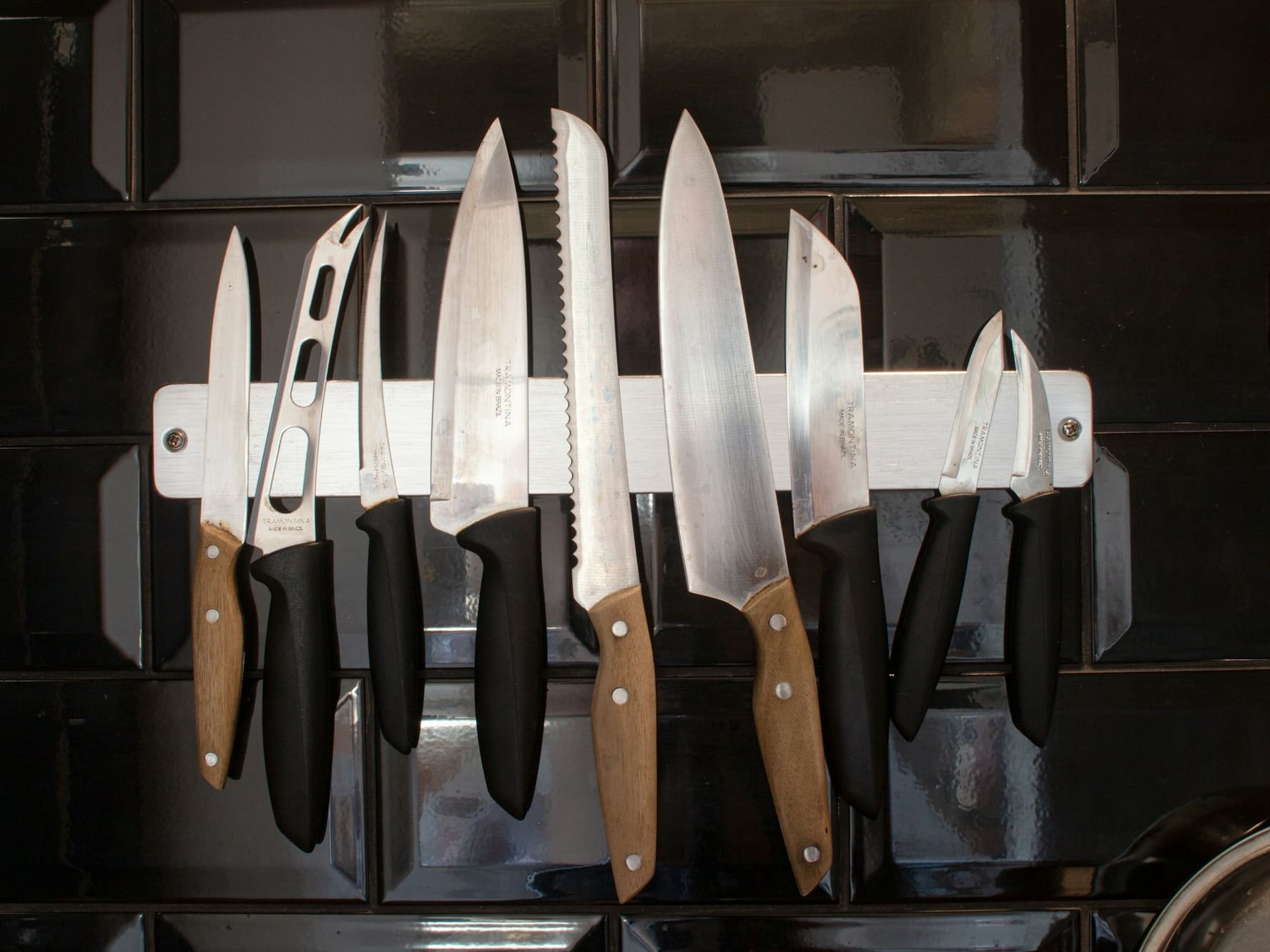
4. Use a Knife-Friendly Cutting Board
Your cutting board is part of your knife-maintenance system.
Every chop ends with the blade contacting the surface beneath the food. A very hard surface can therefore be unnecessarily harsh on the edge.
Cutting Board Comparison
| Surface | Knife-Friendliness | Main Consideration |
|---|---|---|
| Wood | Good | Requires appropriate cleaning and maintenance |
| Plastic | Good | Practical and easy to maintain |
| Bamboo | Varies | Can be relatively hard |
| Glass | Poor | Very hard on knife edges |
| Stone | Poor | Very hard surface |
| Metal | Poor | Avoid as a routine cutting surface |
Wood and suitable plastic are practical choices for everyday knife work.
Avoid routinely cutting directly on:
- Glass
- Granite
- Marble
- Metal
- Other extremely hard surfaces
A beautiful glass cutting board may look good on the counter, but that doesn’t make it a good surface for maintaining a sharp knife edge.
5. Stop Scraping Food With the Cutting Edge
You’ve chopped an onion and want to transfer it to the pan.
It’s tempting to drag the sharp edge of your chef’s knife sideways across the cutting board.
Don’t make that your default habit.
Instead, use:
- The spine of the knife
- A bench scraper
- Another appropriate utensil
The cutting edge is designed primarily for cutting. Repeatedly scraping it sideways against the board creates unnecessary wear.
6. Understand Honing vs. Sharpening
These terms are often treated as if they mean the same thing.
They don’t.
Honing
Honing is an edge-maintenance process. Depending on the knife and honing tool, it can help maintain or refine the existing edge between sharpenings.
Sharpening
Sharpening intentionally removes material to create a new cutting edge.
| Maintenance | Main Purpose | When to Consider It |
|---|---|---|
| Honing | Maintains/refines an existing edge | When appropriate for your knife and edge |
| Sharpening | Re-establishes a dull edge | When the knife is genuinely dull |
| Professional service | Edge restoration/repair | For difficult, valuable, or damaged knives |
The important lesson is that honing isn’t an unlimited substitute for sharpening.
Eventually, a worn edge needs to be sharpened.
7. Don’t Hone Every Knife the Same Way
Before automatically reaching for a traditional honing steel, know what knife you’re maintaining.
Blade hardness, edge geometry, manufacturer recommendations, and the honing tool itself can affect which maintenance method is appropriate.
This is particularly important with specialized or harder Japanese-style knives.
Follow the knife manufacturer’s recommendations when available.
And never treat a serrated bread knife exactly like a straight-edged chef’s knife.
8. Know When Your Knife Needs Sharpening
A knife doesn’t need sharpening simply because a calendar says six months have passed.
How quickly it dulls depends on factors including:
- How frequently you use it
- Blade steel
- Cutting surface
- Cutting technique
- Foods being prepared
- Previous sharpening
Look at performance instead.
Your knife may need sharpening when:
- It no longer slices food cleanly.
- You need noticeably more pressure than before.
- Appropriate honing no longer improves the edge.
- The knife feels dull during ordinary prep.
If normal edge maintenance stops restoring performance, sharpening is the next step.